
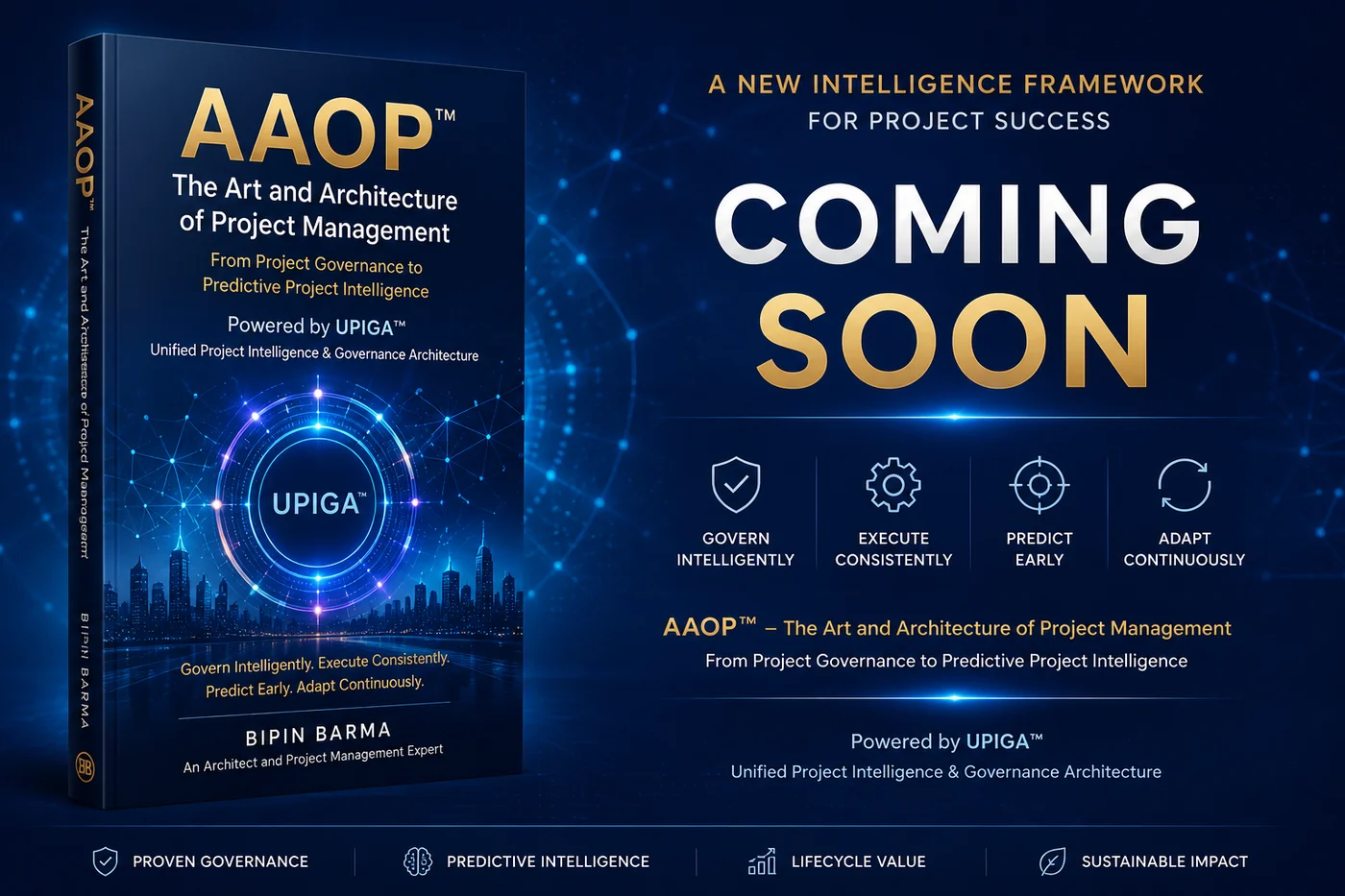
AAOP™ by Bipin Barma
The Art and Architecture of Project Management
From Project Governance to Predictive Project Intelligence
Beyond Process. Towards Architecture.
AAOP™ — The Art and Architecture of Project Management by Bipin Barma is designed to bridge the gap between institutional learning and real-world industry practice. It combines established project management disciplines with governance, execution, organisational capability, cost, time, risk, sustainability, predictive intelligence and AI-enabled decision-making to help professionals and organisations become future-ready.
Projects are no longer isolated delivery exercises. They operate inside complex ecosystems of business expectations, customers, stakeholders, specialist disciplines, technology, regulation, uncertainty and continuous change.
AAOP™ examines how project management can evolve to respond to this environment by connecting governance, execution, domain expertise, business outcomes, digital enablement, predictive intelligence, adaptive response, responsibility, resilience and lifecycle value.
Five persistent gaps in project environments
Fragmentation
Project knowledge often resides across functions, systems and individuals.
Reactive Management
Important interventions frequently occur only after deviations become visible.
Delivery-Centric Success
Handover can become the endpoint even when business and user outcomes have not yet been realised.
Disconnected Intelligence
Projects generate substantial data without necessarily converting it into timely decision intelligence.
Learning Loss
Lessons identified in one project do not always strengthen the next.
AAOP™ seeks to connect these dimensions into a coherent project-management architecture.
For practitioners, leaders and emerging professionals
Six connected capabilities
GOVERN
Governance and decision architecture.
EXECUTE
Structured lifecycle execution.
INTEGRATE
Domain knowledge and cross-functional expertise.
MEASURE
Performance and outcome intelligence.
PREDICT
Earlier visibility of emerging conditions.
ADAPT
Structured responses and continuous learning.